Walking Through Curved Space: What VR Teaches Us About Impossible Geometry

A world that refused to change
For nearly two thousand years, Euclidean geometry was treated as the only possible description of space. Since Euclid's Elements was written around 300 BCE, mathematicians built almost every geometric idea on five simple postulates. Four of these were straightforward. The fifth, known today as the parallel postulate, stood apart. It stated that through a point outside a given line, exactly one parallel line can be drawn.
This single postulate was so much more complicated than the other four that generations of mathematicians assumed it had to be provable from them, a hidden consequence rather than an independent assumption. For centuries they tried to prove exactly that. Every attempt failed.
The breakthrough came in the nineteenth century, when mathematicians stopped trying to prove the postulate and instead asked a different question. What if it simply wasn't true? Surprisingly, replacing it with a different assumption didn't destroy geometry at all. It produced entirely new mathematical worlds that were internally consistent and followed their own logical rules. These became known as non-Euclidean geometries.
This changed mathematics for good. Instead of one correct geometry, there were now multiple valid ways that space itself could behave. The problem was that these new spaces were almost impossible to picture, since human intuition is built entirely around the Euclidean world we live in. So how do you visualise a world your brain was never designed to experience?
When parallel lines behave differently
Two of the non-Euclidean geometries discovered during this period turned out to matter most.
In spherical geometry, parallel lines don't exist at all. Every straight path eventually meets another. Think of the surface of a globe: the shortest route between two cities follows a great circle rather than a line of constant latitude, which is why long flights curve toward the poles instead of tracking a seemingly straighter path on a flat map. Any two great circles eventually intersect, so true parallels simply can't exist.
Hyperbolic geometry is the opposite extreme. Instead of allowing only one parallel through a point outside a line, it allows infinitely many. These parallel paths never intersect the original line, yet they steadily diverge from one another as they extend through space.
This sounds like it should break everything we instinctively believe about geometry, but it's mathematically sound. Hyperbolic geometry keeps all of Euclid's first four postulates and only replaces the fifth. Change one assumption, and you get an entirely different geometric universe. Many of its properties can't really be explained through equations alone. They need to be experienced.
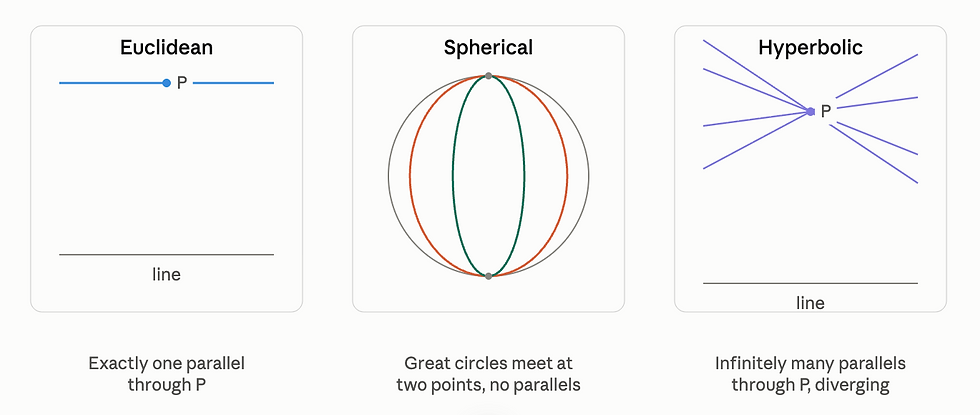
Figure 1: Parallel Lines in Euclidean, Spherical, and Hyperbolic Geometry
From Flat Models to Immersive Worlds
Long before virtual reality existed, mathematicians were already searching for ways to represent hyperbolic space visually. Several models were developed, each preserving different properties. The Beltrami-Klein model keeps straight lines straight but distorts angles. The Poincaré disk model preserves angles but represents straight lines as curves. The Poincaré half-plane model also preserves angles, mapping the geometry onto an infinite half-plane instead.
These models made hyperbolic geometry easier to study, but they all shared the same limitation. None of them actually placed the viewer inside the geometry. They were still Euclidean drawings of a non-Euclidean world. M. C. Escher famously used the Poincaré disk model as the mathematical foundation for his Circle Limit woodcuts, and later, programs like Curved Spaces and the game HyperRogue let users interact with hyperbolic geometry through a screen. But a screen is still a flat window. No matter how convincing the graphics got, the viewer always stayed outside the geometry.
Virtual reality changes that relationship completely. Instead of observing hyperbolic space, the user moves within it. Head movements, walking, and changes in orientation all become part of the mathematical experience itself, which let the geometric properties be encountered directly rather than just viewed.
Feeling Holonomy and Geodesic Divergence:
The most striking thing VR does is turn abstract definitions into physical sensations.
In ordinary Euclidean space, moving in a small circle and returning to your starting point leaves your orientation unchanged. Hyperbolic space doesn't behave this way, because of a property called holonomy. It describes what happens when an object is carried around a closed path while its direction is kept fixed: on a curved surface, arriving back where you started doesn't guarantee you're facing the same way. A classic example is a triangle drawn on a sphere, where an arrow ends up rotated even though it was never deliberately turned. In hyperbolic VR, users feel this directly. Moving their head through a circular motion makes the world around them slowly rotate, even though they haven't turned at all.
The second phenomenon is geodesic divergence. In Euclidean geometry, parallel paths stay a constant distance apart. In hyperbolic geometry, they steadily separate instead. Looking straight ahead traces a geodesic, and the floor beneath a user's feet acts as a parallel path to it. Because the two diverge, the floor gradually appears to fall away into the distance. Walking forward can even create the sensation of the ground disappearing beneath your feet.

Figure 2: Visualising Geodesic Divergence in Hyperbolic VR
When seeing becomes Part of the Mathematics
Hyperbolic geometry also changes something we rarely question: how we judge depth. VR relies on stereopsis, where each eye gets a slightly different image and the brain combines them to estimate distance. In Euclidean space, focusing on something far away keeps the eyes nearly parallel, while nearby objects pull the eyes inward.
In hyperbolic space, the viewing rays from each eye diverge instead of staying parallel. That means focusing on a distant object actually requires the eyes to point inward more, not less, which is normally the cue for closeness. The result is that distant objects look deceptively close, and a user's ordinary sense of depth stops being reliable. This is essentially how a hyperbolic being would naturally see its own world.
That leaves developers with a real design choice. They can preserve this mathematically accurate but disorienting perception, or render the scene using familiar Euclidean depth cues that are easier to navigate but less authentic to the geometry. Neither option is simply better. One teaches how a hyperbolic being would perceive space, and the other makes the environment easier for beginners to move through.
Filling an Impossible World
An empty virtual world wouldn't reveal much about its geometry, so hyperbolic VR environments are filled with repeating structures that expose the underlying rules. In Euclidean space, cubes tile perfectly, with four cubes meeting around each edge, the familiar arrangement you see in buildings and city blocks.
Hyperbolic space allows a different tiling, where six cubes meet around each edge instead of four, something that's impossible in ordinary Euclidean geometry. Each room still looks perfectly normal from the inside, but moving through the space gradually reveals that the rules underneath are different.
One particularly interesting result shows up when users repeat the same sequence of movements. They can complete what feels like a closed loop and end up back at their starting point inside the virtual world, while their actual, physical body has shifted position in the tracked real-world space. Their movement through Euclidean space no longer matches their movement through hyperbolic space. It's a tangible, physical demonstration that the geometry itself has changed.
Beyond Visualisation
Although these environments were originally built to teach geometry, their significance goes further. Hyperbolic VR gives mathematicians new ways to investigate spaces that are otherwise hard to imagine, and it opens up science communication to people with little formal mathematical background.
Looking ahead, this points toward William Thurston's eight three-dimensional geometries, of which hyperbolic space is just one member. Researchers are already developing VR environments for others in the family, including Nil and Sol spaces, whose twisting and stretching properties are even less intuitive than hyperbolic geometry.
The story started with a single question about parallel lines. Two centuries later, virtual reality lets us step inside the answer. Instead of asking us to imagine impossible worlds, it turns those worlds into something temporarily real, and turns geometry from something we calculate into something we can inhabit.
Reference:
Skrodzki, M. (n.d.). Illustrations of non-euclidean geometry in virtual reality ‘out of nothing I have created a strange new universe.’ (János Bolyai). Retrieved https://arxiv.org/pdf/2008.01363


Comments